

Restaurant Exhaust Fan Buying Guide: Commercial Kitchens
A restaurant exhaust fan is the mechanical heart of any commercial kitchen ventilation system, designed to pull heat, smoke, steam, and grease-laden vapors out of the cooking area to maintain a safe, clean, and code-compliant environment. For commercial kitchen operators, selecting the right ventilation equipment is one of the most critical decisions in a build-out or replacement project. The right setup not only keeps your staff comfortable but also ensures your business passes local building inspections the first time. If you are comparing your options before purchasing, be sure to check out our commercial kitchen exhaust fan buyer's guide for an in-depth look at complete ventilation design.
At AirSupply Corp, we specialize in helping restaurant owners, food truck operators, and ghost kitchen managers source high-quality, commercial-grade ventilation components straight from the factory. By choosing a component-based DIY approach rather than purchasing expensive, pre-integrated turnkey packages, you can save 60-70% on equipment costs.
Call our team at (832) 540-7936 for a free ventilation sizing consultation, or use our live chat to speak with a named rep who can help you build a permit-ready system today.
In this guide, we will walk you through the different types of restaurant exhaust fans, how to size them for your kitchen, and what local code regulations you must follow.
What Types of Restaurant Exhaust Fans Should You Consider?
Commercial kitchen ventilation systems rely on different fan configurations depending on where the air is being exhausted, the routing of the ductwork, and whether the kitchen is dealing with heavy grease or simple heat and moisture. According to the U.S. Environmental Protection Agency (EPA), a complete local exhaust ventilation system is composed of four key elements: hoods to capture emissions, ductwork to convey them, stacks to disperse them, and fans to provide the energy to move the air (EPA Design Guide). Here are the three main fan types used in food service:
1. Upblast Exhaust Fans
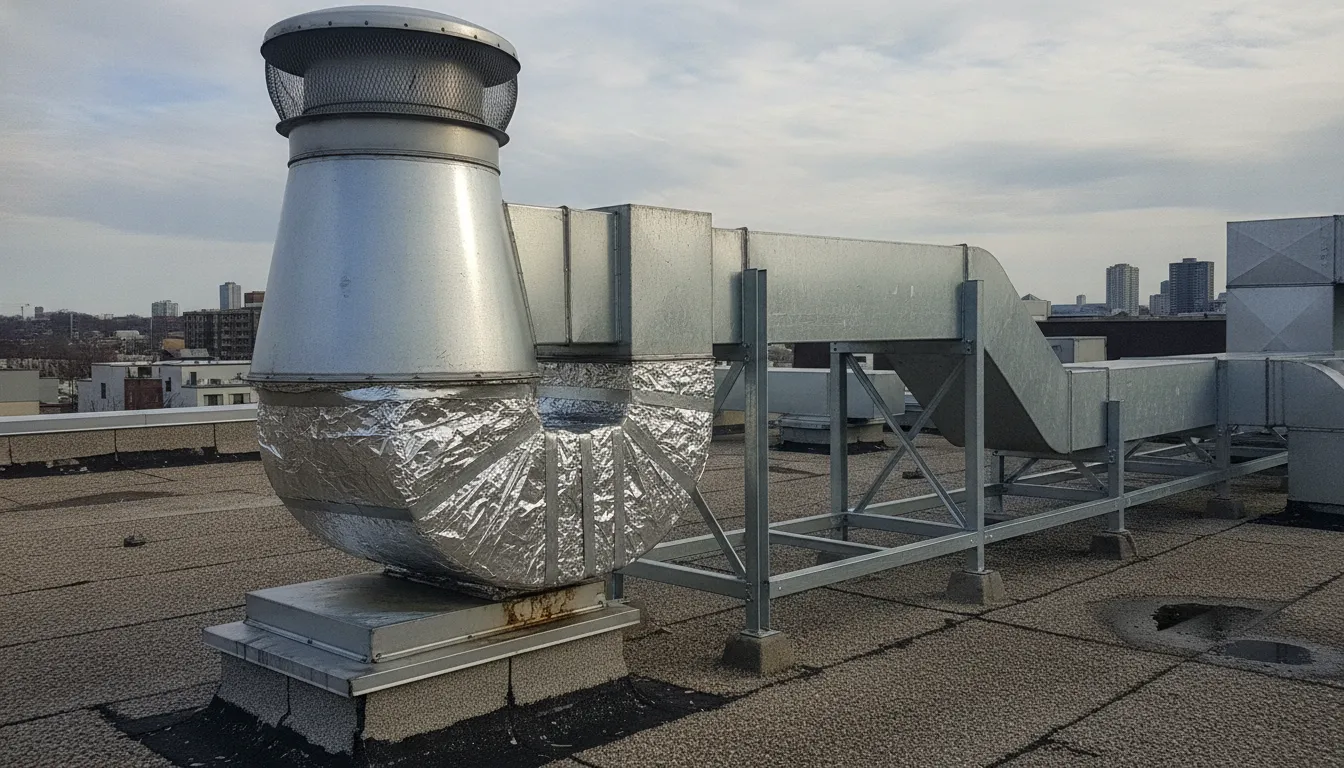
Upblast exhaust fans are the industry standard for grease-laden air and Type 1 hood installations. These fans are mounted externally on the roof or an exterior wall. They are designed to discharge exhaust air straight up and away from the building, preventing grease from building up on the roof surface and creating a severe fire hazard. When selecting an upblast fan, operators must consider the environment in which it operates, such as ensuring heavy-duty construction that can withstand outdoor exposure and the mechanical abuse inherent to commercial exhaust environments (CDC Ventilation Design Guide). At AirSupply, our direct-drive upblast exhaust fan models range from 2,050 CFM to 4,000 CFM capacities, perfect for food trucks and independent restaurants. Explore our complete restaurant exhaust fan collection to compare models.
2. Inline Exhaust Fans
Inline fans are mounted directly inside the ductwork run, typically inside the building's ceiling or attic space. Because the motor is in the airstream, standard inline fans are generally reserved for non-grease-laden applications, such as Type 2 hoods over dishwashers, steam tables, or general HVAC ventilation. They are ideal when roof space is limited or when exhausting air over long horizontal duct runs.
3. Utility Set Exhaust Fans
Utility sets are heavy-duty, belt-driven centrifugal fans housed in a protective steel enclosure. They are used for high-volume, high-resistance applications where long duct runs or multiple bends create high static pressure. Utility sets are common in multi-story buildings where the exhaust air must be pulled through vertical shafts over several floors before being discharged.
How Much CFM Do You Need for a Restaurant Kitchen?
Choosing the correct airflow capacity, measured in Cubic Feet per Minute (CFM), is the most critical part of sizing your restaurant exhaust fan. Sizing a restaurant exhaust fan requires balancing the volume of air exhausted against the static pressure of the entire ventilation system to ensure consistent capture performance. Undersizing your fan will result in smoke and grease escaping into the dining area, while oversizing will pull conditioned air out of the building unnecessarily, driving up utility bills.
According to federal safety guidelines, the primary purpose of a commercial kitchen ventilation system is to protect the health and well-being of workers (CDC Guidelines). Sizing must be sufficient to maintain proper capture and containment at the hood to prevent smoke and grease escape. To size your system accurately, follow these engineering steps:
- Identify cooking appliances and duty ratings: Classify your equipment into light-duty (ovens, steamers), medium-duty (griddles, fryers), or heavy-duty (charbroilers, woks).
- Determine hood length and overhang: Your commercial hood must overhang the cooking equipment by at least 6 inches on all open sides to capture thermal plumes.
-
Calculate required exhaust CFM: Sizing is typically based on the linear feet of the hood. As a general guide:
- Light-Duty Equipment: Requires ~150 to 250 CFM per linear foot of hood.
- Medium-Duty Equipment: Requires ~250 to 350 CFM per linear foot of hood. For example, a medium-duty 6-foot hood typically requires a 2500 CFM upblast fan.
- Heavy-Duty Equipment: Requires ~400 to 550+ CFM per linear foot of hood.
- Calculate static pressure: Ductwork, elbows, and grease filters create resistance (static pressure). The fan motor horsepower (HP) must be sufficient to overcome this resistance while maintaining the targeted CFM.
Grease-Laden vs Non-Grease-Laden Exhaust: What Does NFPA 96 Require?
Commercial ventilation design is heavily regulated by local building codes, which are typically based on the National Fire Protection Association (NFPA) 96 standard and the International Mechanical Code (IMC). The type of air your kitchen exhausts determines the type of hood and fan you must install.
Type 1 Hoods (Grease-Laden Vapors)
Any appliance that produces grease, smoke, or heavy grease-laden vapors, such as commercial fryers, griddles, charbroilers, and woks, requires a Type 1 hood. NFPA 96 mandates that Type 1 systems use exhaust fans specifically rated for grease-laden air (typically UL 762 listed upblast fans). These systems require robust, fire-rated ductwork designed to withstand high heat and grease buildup. Additionally, the minimum air velocity through the duct system must be maintained at 500 feet per minute to properly capture and convey grease-laden cooking vapors out of the kitchen (NFPA Code Reference).
Type 2 Hoods (Condensate and Heat)
Appliances that produce only steam, heat, or moisture, such as commercial dishwashers, pasta cookers, and pizza ovens, can use a Type 2 hood. These hoods use standard exhaust fans focused on removing steam and vapors without the strict grease-filtration and fire-containment rules of Type 1 systems.
The Make-Up Air Requirement
One of the most common mistakes in restaurant kitchen design is neglecting make-up air. Under IMC rules, make-up air is mandatory for commercial kitchen ventilation systems when the exhaust rate exceeds 400 CFM to maintain proper building pressure. If your exhaust fan pulls 2,500 CFM of air out of the kitchen, you must replace that air. Without a make-up air unit, your kitchen will develop negative air pressure, causing doors to slam, drafts, and exhaust backdrafting. To keep your system balanced, explore our selection of commercial make-up air units. For high-throughput setups requiring a 4000 CFM high-capacity fan, a balanced make-up air system is absolutely essential to pass code inspections.
What to Look for in a Restaurant Exhaust Fan: Specs Checklist
When selecting a restaurant exhaust fan, modern engineering principles supported by rigorous testing should guide your choice, replacing old-school rule-of-thumb guesswork (CDC Guidelines). Use this specs checklist to evaluate models:
- UL 762 Listing: Crucial for Type 1 hoods. This ensures the fan is specifically rated to handle grease-laden air at high temperatures.
- CFM and Horsepower (HP): Ensure the motor has the necessary horsepower to maintain the rated CFM against your ductwork's static pressure.
- Construction Material: Heavy-gauge, rust-resistant aluminum is the standard for upblast fans to withstand severe outdoor weather.
-
Drive Type (Direct vs. Belt):
- Direct Drive: The fan blade is attached directly to the motor shaft. This is highly efficient, requires less maintenance, and is perfect for food trucks and small restaurants.
- Belt Drive: The motor drives the fan blade via a belt, allowing for adjustable speeds. These are common in high-capacity systems but require regular belt replacement and maintenance.
- Grease Drain and Collector: NFPA 96 requires upblast fans to have an integrated grease drain and collection cup to prevent grease from leaking onto the roof.
- Hinged Base: Allows the fan to be easily tilted back for duct cleaning and inspection, which is an NFPA 96 requirement.
Restaurant Exhaust Fan Cost: What to Budget and Where to Save
Sourcing commercial kitchen ventilation equipment can be incredibly expensive if you go through traditional full-service installers or local HVAC contractors who mark up equipment costs. By purchasing your components individually and utilizing a local contractor for installation, you can secure huge savings. A complete DIY system from AirSupply, including a grease-rated upblast exhaust fan, a Type C hood, and accessories, runs about $900, compared to competitor package prices that start at $2,259 and can easily exceed $5,000.
Here is a quick look at typical equipment cost comparisons:
| Equipment Component | AirSupply Component Price (Wholesale) | Turnkey Package Price (WebstaurantStore/HoodMart) |
|---|---|---|
| Upblast Exhaust Fan (2,050 CFM) | $550 | $1,100 - $1,800 |
| Upblast Exhaust Fan (2,500 CFM) | $650 | $1,300 - $2,100 |
| Upblast Exhaust Fan (4,000 CFM) | $750 | $1,600 - $2,800 |
| Type C Ventilation Hood (6ft - 12ft) | Component-Based Pricing | Included in $2,259+ packages |
Investing in technical sizing consultations before you buy is the best way to avoid expensive mistakes. Sizing errors can lead to code inspection failures, system rebuilds, or premature motor burnout. Our expert team at AirSupply provides free sizing and code guidance to ensure you receive the exact, permit-ready components you need to pass inspection the first time.
Frequently Asked Questions
What size restaurant exhaust fan do I need?
The size of your restaurant exhaust fan is determined by the linear length of your ventilation hood and the type of cooking equipment underneath it. For medium-duty appliances like griddles or fryers, a standard guideline is 250 to 350 CFM per linear foot of hood. For example, a 6-foot hood typically requires a 2,500 CFM exhaust fan, balanced against the ductwork's static pressure resistance.
How do I choose the right commercial kitchen exhaust fan?
To choose the right fan, you must first determine if your kitchen requires a grease-rated upblast fan (for Type 1 hoods handling grease and smoke) or a non-grease utility/inline fan (for Type 2 hoods handling steam and heat). You must then calculate your required CFM, determine the static pressure resistance of your ductwork run, and choose between direct-drive and belt-drive motors.
How often should I clean my restaurant exhaust fan?
NFPA 96 codes dictate regular cleaning schedules based on cooking volume. High-volume kitchens (such as 24-hour operations or heavy charbroiling) require monthly cleaning. Moderate-volume kitchens should clean their fans, hoods, and ductwork quarterly, while low-volume operations (such as seasonal kitchens) can schedule cleaning semi-annually or annually.
What is the minimum duct velocity for restaurant exhaust fans?
According to NFPA 96 standards, the minimum air velocity through the duct system for grease-laden air must be maintained at 500 feet per minute. This velocity is necessary to ensure grease vapors do not condense and settle inside the ductwork, where they can build up and present a significant fire hazard.
Why is static pressure important when choosing an exhaust fan?
Static pressure represents the resistance to airflow created by your hood, grease filters, ductwork runs, and any elbows or bends in the system. Your exhaust fan must be rated to deliver the required CFM airflow at your system's specific static pressure, which determines the required motor horsepower (HP) to operate effectively.
Get a Free Ventilation Sizing Consultation Today
At AirSupply Corp, we are committed to making commercial kitchen ventilation affordable and straightforward for independent restaurant owners, food truck operators, and ghost kitchen startups. We offer durable, commercial-grade upblast exhaust fans, Type C hoods, and make-up air systems at unbeatable wholesale prices, shipping direct from the factory with a 24-to-48-hour window on stocked units.
We do not believe in one-size-fits-all guesswork. Our expert team provides free sizing consultations and code-compliance guidance to help you configure a permit-ready system tailored to your exact kitchen layout. Call our support team today at (832) 540-7936 or click our live chat widget to speak with a named rep and get your free, customized ventilation sizing quote.