

Commercial Upblast Exhaust Fan Buyer's Guide for Restaurants
A commercial upblast exhaust fan is a specific ventilation unit that pulls grease-laden air. Heat and smoke from a kitchen hood and exhausts it upward away from the building roof. These centrifugal fans are essential for meeting NFPA 96 standards, which require the safe control of fire risks in commercial cooking spaces. By venting waste air straight up, the fan prevents grease from settling on the roof surface, which reduces fire hazards and structural damage. Most restaurant and food truck operators need a unit with a capacity between 2,050 and 4,000 CFM to maintain proper airflow. Choosing the right fan size ensures your kitchen stays cool, smells fresh, and follows local health and safety codes.
Ready to find the right commercial upblast exhaust fan for your kitchen? Call (832) 540-7936 for a free consultation or browse our upblast fans online.
Finding the right kitchen ventilation can feel hard, but the process is simple when you know the expert basics. This guide breaks down the sizing, code, and cost factors to help you make a smart choice. The path begins with a close look at What Is a Commercial Upblast Exhaust Fan?
What Is a Commercial Upblast Exhaust Fan?
A commercial upblast exhaust fan is a heavy-duty tool made to pull hot air, smoke, and grease out of a kitchen. Most people install these fans on the roof of a restaurant or food truck. Unlike other fans that blow air out the side, these units push air straight up into the sky. This design keeps grease from sticking to your roof, which helps stop fires and keeps your building clean.
Vertical Discharge and Centrifugal Design
The main goal of this fan is to move grease-laden air far away from your building. It uses a vertical discharge path to blow exhaust away from the roof surface. Inside the metal housing, a centrifugal blower wheel spins at high speeds. This wheel creates the strong pull needed to move thick air through long ducts. Centrifugal fans handle grease much better than common propeller fans.
By pushing air up instead of out, you lower the risk of fire and roof damage. Grease that lands on a roof can rot the surface or catch fire over time. These fans help collect that grease so it stays off your shingles or metal. This setup is a key part of any safe kitchen design. Based on data from the Centers for Disease Control and Prevention, proper airflow is vital for worker health and safety. See our guide to commercial ventilation requirements for more details. Good airflow removes smoke and odors that can harm your team. Our make-up air units balance exhaust flow to maintain healthy air pressure.
Heavy Duty Build
These fans are built to last in harsh weather. Most units feature a rust-proof aluminum body and a strong steel base. They sit on a roof curb, which is a metal box that joins the fan to your roof. This mounting style keeps the unit stable even during high winds or heavy rain. For ductwork components, browse our commercial kitchen duct work collection. The motor sits in its own house to keep it safe from grease and heat. Accessories like grease traps and filters complete your ventilation setup.
Because these fans handle grease, they must follow strict safety codes. They are a must-have for any kitchen with a Type I hood. By venting air high above the roof line, you meet local laws and keep your kitchen running smooth. It is a simple way to protect your money and your staff at the same time.
Direct Drive Power and Capacity
New upblast fans use direct drive motors with the motor joined directly to the fan wheel. No belts to slip or break means less maintenance, steady airflow, and quieter operation for busy kitchens.
AirSupply offers three main sizes to fit your needs. You can find units that move from 2,050 to 4,000 cubic feet of air per minute (CFM). Food trucks typically need the 2050 CFM model, while larger kitchens and ghost kitchens require 4000 CFM. Browse our upblast fan specs. If you are not sure which size is best, our team can help you pick the right model for your hood. Use our free fan sizing consultation to get expert guidance.
How Does a Centrifugal Upblast Exhaust Fan Work?
A commercial upblast exhaust fan uses a centrifugal blower wheel spinning at 1725 RPM to pull grease-laden air through kitchen hood filters and ducts. Then discharges it vertically away from the roof surface. The direct-drive motor connects straight to the fan wheel for reliable, low-maintenance operation.
A centrifugal upblast exhaust fan is a tough machine built to pull hot, greasy air out of your kitchen and push it away from your roof. Unlike basic fans that blow air in a straight line, these units use a spinning wheel to change how the air flows. This design helps the fan handle the thick, heavy smoke and grease found in food trucks and restaurants while following safety codes.
The path of the air
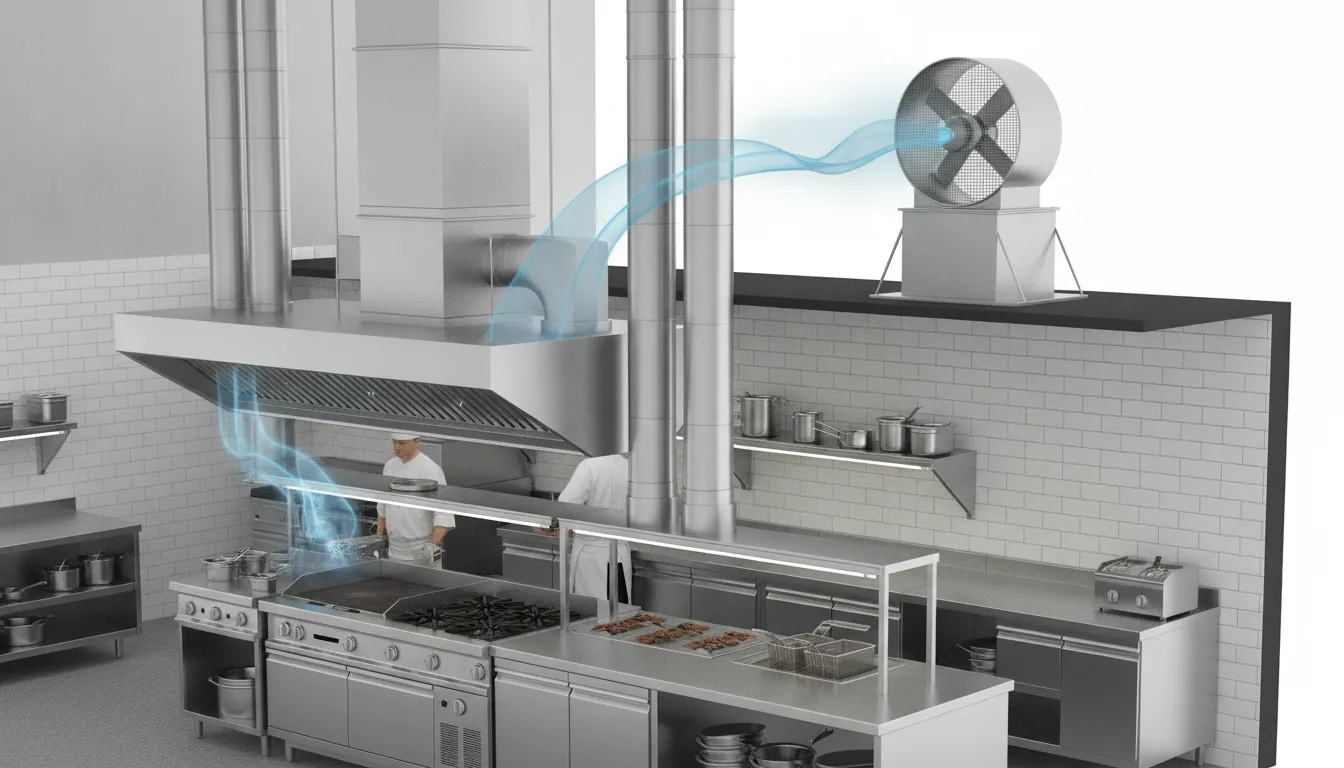
The work starts at the hood above your stove. When the motor turns on, the fan creates a pull that draws air through your grease filters. These filters catch large drops of grease before the air enters the vents. The air then travels through the ducts to the fan box on your roof. Once there, the air enters the center of a spinning wheel. This wheel uses force to fling the air out and up. This vertical blast keeps grease away from your roof to prevent damage and fires.
- The fan draws air into the hood and through the grease filters to catch large bits.
- Greasy air moves through the ductwork until it reaches the fan box on the roof.
- A wheel spins at 1725 RPM to pull the air into the center of the fan.
- The wheel flings the air out and sends it up, well above the roof line.
- The unit moves grease into a cup to keep the motor and roof clean.
Static pressure and motors
Static pressure is the push the fan must give to move air through ducts and filters. For a commercial upblast exhaust fan to work, it must beat a pressure range of 0.6 to 1.5 in. w.g. You can use ventilation design procedures to find the right pressure for your shop. An undersized fan leaves smoke in the kitchen, while an oversized one wastes power and creates noise.
Most small kitchens use a direct-drive motor. In these models, the fan wheel sits right on the motor shaft. This setup has fewer parts to break than belt-drive fans, which makes it easy to maintain. By choosing direct-drive, you keep the motor away from the hot grease path. This helps your tools last long and run well. If you are not sure which motor you need, read our choosing the right commercial kitchen fan guide for more tips.
How to Choose the Right CFM for Your Commercial Kitchen.
To choose the right CFM, measure your hood length in feet and multiply by the CFM rate for your cooking type: 150-250 CFM/ft for light cooking. 250-400 for medium, and 400-600 for heavy frying. Add 25-40% for island hoods, then balance with a make-up air unit at 80-90% of exhaust capacity.
Picking the right cubic feet per minute (CFM) rate is the most vital part of sizing your setup. CFM measures how much air your commercial upblast exhaust fan pulls out of the room each minute. If the rate is too low, grease and smoke will stay in the air. If it is too high, you waste power and make the kitchen too loud. Most pros follow standard air rates based on the type of tools you use under the hood.
Check air needs by cooking type
Your cooking gear sets how much heat and grease your fan must handle. Light tools like ovens or steamers only need 150 to 250 CFM for each foot of hood length. Medium gear like griddles or ranges usually needs 250 to 400 CFM per foot. For heavy tasks like frying, you need a calculating required CFM for your kitchen plan that hits 400 to 600 CFM per foot. This helps your system meet the standard for ventilation control and fire safety in food spaces.
Use the hood sizing math
To find your total CFM, start with the length of your hood in feet. Multiply that length by the CFM rate for your specific cooking duty. For example, an 8-foot hood over heavy fryers at 300 CFM per foot would need a 2,400 CFM fan. Note that island hoods need more power since they are open on all four sides. You should add 25% to 40% to your total for island setups to keep the air clear. Proper commercial ventilation requirements also depend on your duct path, as bends or long runs slow down the flow.
Balance air with a make-up unit
A fan cannot work well if it has no new air to pull from. You must use a make-up air unit to replace the air you exhaust. This stops negative pressure, which can make doors hard to open and cause air to flow back into the room. A good rule is to set your make-up air at 80% to 90% of your total exhaust CFM. This balance keeps your industrial ventilation design safe and smooth. Proper air flow ensures your fan hits its rated power and keeps the room cool for your team.
AirSupply Upblast Exhaust Fan Models Compared.
AirSupply offers three direct-drive upblast fan models: the E-DUC-1010 (2050 CFM, $550) for food trucks. The E-DUC-1212 (2500 CFM, $650) for mid-size restaurants, and the E-DUC-1214 (4000 CFM, $750) for high-volume operations. All run on 115V single-phase power.
Choosing the right commercial upblast exhaust fan depends on your kitchen size and cooking volume. AirSupply offers three core direct-drive models to meet these needs. Each model uses a 115V single-phase motor at 1725 RPM for steady work. These fans are built for NFPA 96 compliance when moving grease-laden air. You can also shop our commercial upblast exhaust fans online to find the best fit for your roof curb.
Small kitchens and food trucks
The E-DUC-1010 is our most compact choice. It gives 2050 CFM with a 1/2 HP motor for only $550. This model is a top choice for food truck owners, who make up about 40% of our customers. Its small size fits well in mobile kitchens where space is tight but code rules still apply. It has enough power to handle standard griddles and ranges in small shops.
Mid-range restaurant needs
For standard local restaurants, the E-DUC-1212 offers a step up in power. This $650 model moves 2500 CFM using a 3/4 HP motor. It handles the higher heat and smoke found in kitchens with 10 to 100 seats. If you are choosing the right commercial kitchen fan for a new build, this mid-sized unit is often the best choice for price and air flow.
Large and high-volume operations
The E-DUC-1214 is our most powerful fan. It costs $750 and moves 4000 CFM with a 1 HP motor. This unit is built for large kitchens or ghost kitchens that run many fryers and charbroilers at once. These sites need strong air flow to keep the air clear. All our models include a 1-year warranty. Some buyers can get 0% APR financing from $45.13 per month.
AirSupply offers three upblast exhaust fan models sized for different kitchen volumes.
| Model. | CFM. | HP. | Price. | Best For. |
|---|---|---|---|---|
| E-DUC-1010. | 2050. | 1/2 HP. | $550. | Food Trucks. |
| E-DUC-1212. | 2500. | 3/4 HP. | $650. | Mid-size Kitchens. |
| E-DUC-1214. | 4000. | 1 HP. | $750. | High Volume. |
Upblast vs. Other Commercial Exhaust Fans: Which Is Right for You?
Upblast centrifugal fans outperform inline and axial fans for commercial kitchens because they handle grease better. Build higher static pressure for long duct runs, and discharge air vertically to protect the roof. Direct-drive models require less maintenance than belt-drive alternatives.
Picking the right fan is key to a safe and clean kitchen. While many fans move air, only a few can handle the heat and grease of a busy cook line. Most owners find that a commercial upblast exhaust fan is the best choice for roof-top use. These units discharge grease vertically to keep it off your roof. This helps you follow local health and fire codes while protecting your building structure.
Upblast vs inline and axial fans
Inline fans sit inside the duct run and are great for clean air, but they often fail in greasy kitchens. Axial fans use a propeller to move large amounts of air, but they lack the power to push air through long ducts. In contrast, centrifugal upblast fans use a wheel design that builds high static pressure. This power is needed to pull heavy smoke through filters and ducts. These fans also handle grease better than axial models by keeping the motor out of the air stream.
Proper airflow speed is also vital to keep your ducts clean. You must maintain enough air velocity to prevent grease from sticking to the inside of the pipes. industrial ventilation design and fire safety. Without this force, grease builds up and creates a major fire risk in your kitchen.
Roof-mounted vs wall-mounted units
Wall-mounted fans cost less to install but blow grease onto exterior walls, causing stains. Upblast fans mount on the roof and vent straight up, keeping grease away from the building. For most food trucks and restaurants, choosing the right commercial kitchen fan means looking at where the waste will land. Roof mounting is usually the cleanest and safest path.
Commercial fan comparison guide
The table below shows how common fans stack up for kitchen use. For most owners, the centrifugal upblast fan is the clear winner for grease and code rules.
| Fan Type. | Mounting. | Grease Handling. | Static Pressure. | Best Use. |
|---|---|---|---|---|
| Upblast Centrifugal. | Roof or Wall. | Excellent. | High. | Greasy Kitchens. |
| Inline Fan. | In-Duct. | Poor. | Medium. | General Airflow. |
| Axial Fan. | Wall or Roof. | Low. | Low. | Warehouses. |
| Wall-Mounted Axial. | Side Wall. | Medium. | Low. | Small Cafes. |
Direct drive vs belt drive fans
Direct drive fans have a motor that connects straight to the fan wheel. This setup has fewer parts and needs less work to keep running. Most small to medium kitchens prefer this for its ease of use. Belt drive fans use a belt to turn the wheel, which changes fan speed but requires more maintenance. Keeping your fan motor clean and safe from grease will help any fan last longer and run well.
NFPA 96 Code Requirements for Commercial Exhaust Fans.
NFPA 96 requires Type I hoods over grease-producing appliances, 16-gauge welded steel ducts. An 18-inch clearance between ducts and combustibles, and professional cleaning every 3 months for high-volume kitchens. Make-up air is required when exhaust exceeds 400 CFM.
Following NFPA 96 standards is vital for any commercial kitchen to manage grease and fire risks. These rules cover the design and care of hoods, ducts, and fans to keep your staff safe. Failing to meet these codes can lead to fines or fires that spread through the duct work.
Grease Duct and Hood Basics
You must use a Type I hood for any tool that makes grease or smoke. These hoods trap vapors before they enter the exhaust system. To meet commercial ventilation requirements, your grease ducts must use 16-gauge welded black iron or 18-gauge stainless steel. This thick metal helps stop heat if a fire starts inside the line.
Clearance and Makeup Air Rules
Safety codes need an 18-inch gap between grease ducts and things that can burn. You can reduce this to 3 inches with a tested fire shield. Our commercial upblast exhaust fans are built to meet these strict NFPA 96 discharge rules.
The International Mechanical Code requires makeup air when exhaust exceeds 400 CFM. This balances building pressure and prevents smoke from spilling back into the cooking area.
Cleaning and Inspection Cycles
Grease buildup is a fire hazard. High-volume kitchens need professional cleaning every 3 months, plus weekly baffle filter washing to maintain airflow. An annual professional inspection checks for leaks and system damage.
How Much Does a Commercial Upblast Exhaust Fan Cost?
AirSupply commercial upblast exhaust fans range from $550 to $750. A complete DIY ventilation system including a fan, hood, and make-up air unit costs approximately $900. This component-based approach saves 60-70% compared to integrated packages from other suppliers.
The cost of a commercial upblast exhaust fan depends on its airflow capacity and motor power. At AirSupply Corp, our standard units range from $550 to $750. A 2050 CFM model starts at $550, while a larger 4000 CFM fan for heavy-duty kitchens costs about $750. These prices reflect our component-based wholesale model.
Building a complete kitchen system
Buying a fan is just one part of setting up your kitchen. A full, code-compliant ventilation system needs a hood, a fan, and a make-up air unit to work safely. You can build a complete DIY system through AirSupply for about $900, including a fan ($550-$750), a Type C ventilation hood, and basic duct connectors. This is a big saving compared to integrated packages from other stores. Our component-based model means you pay only for what you need, without markups.
For context, some big stores sell integrated hood and fan packages for $2,259 to $7,399. Other brands often start their custom systems at $2,000 and can go up to $20,000 for large setups. By choosing your own parts, you can save 60 to 70 percent on your total equipment costs.
Flexible payment and financing options
Qualified buyers get 0% APR financing from $45.13/month for a full setup. There are no minimum order requirements.
Every purchase comes with our expert help to ensure you get the right size for your space. It is vital to check your specs before you buy. If you are unsure about calculating required CFM for your kitchen, our team offers free sizing help. Proper sizing is not just about cost. It is needed by the Centers for Disease Control and Prevention to keep your workers safe from heat and smoke.
How to Install and Maintain Your Commercial Upblast Exhaust Fan.
Commercial upblast exhaust fans need professional cleaning every 3-6 months, weekly baffle filter washing, and annual inspections. Key tasks include checking motor bearings, cleaning the fan wheel, and inspecting roof curb seals.
Setting up your commercial upblast exhaust fan correctly is the first step toward a safe kitchen. Proper setup keeps your workspace clear of smoke and odors while protecting your roof from grease damage. Following a clear plan for both setup and care helps you meet safety rules and keep your gear running well for years.
Installing your fan on the roof
Mounting your fan starts with a solid roof curb. You must secure the fan base to this curb to stop shaking and frame damage to your building. Most fans for food trucks use a 115V single phase link. This makes them easy to wire into standard power systems. You will then connect the duct run from your exhaust hoods directly to the base of the fan to create a tight seal for grease-laden air.
- Secure the roof curb. Install a structural curb on your roof that matches the base size of your fan model.
- Mount the fan base. Lift the fan onto the curb and bolt the base securely to stop any movement or noise during use.
- Connect the ductwork. Attach the vertical duct from the hood below to the throat of the fan using high-heat sealant.
- Wire the motor. Connect the 115V power lines to the motor box. Be sure to ground the unit to meet local codes.
- Verify airflow direction. Turn the fan on to check that it spins correctly and pulls air up through the duct.
Keeping the air moving safely
Regular care is the only way to stop grease from building up and starting a fire. You must maintain proper airflow speed in the exhaust duct to keep grease moving out instead of sticking to the walls. We recommend checking your fan wheel and housing every three months for any grease film. If the fan blades get heavy with grease, the wheel can shake. This will slowly break the motor bearings over time.
Good airflow is also key for protecting workers from lung health hazards in a hot kitchen. Beyond the fan itself, you should clean your hood filters at least once a week. This stops grease from entering the duct. For busy kitchens, a deep clean of the system every 90 days is often a legal rule under NFPA 96 standards. If you are unsure about your setup, AirSupply offers a free chat to give you sizing guidance.
Frequently Asked Questions.
The E-DUC-1010 fits standard food truck roof curbs and handles 2050 CFM with a 1/2 HP motor. Making it ideal for mobile kitchens where space and electrical capacity are limited. It meets NFPA 96 requirements for small cooking operations.
What are the common replacement parts for upblast exhaust fans?
Common parts include grease filters, fan wheels, and motors. Regular cleaning of grease filters prevents fire risks. You should also check the motor and fan wheel for wear each year. Replacing these small parts helps your system last longer. According to the NFPA 96 standard, keeping these parts in good shape is key for safety and fire prevention.
Are used commercial upblast exhaust fans a good investment?
Buying used fans can be risky due to hidden grease buildup or motor wear. Since grease is a major fire hazard, a used fan may need deep cleaning or new parts right away. New units from AirSupply Corp are often cheaper than used premium brands. You can get a new, code-compliant system for about $900. This low price makes buying new a safer and more cost-effective choice for most small kitchens.
How do I know if I need a single-phase or three-phase motor?
Most small to mid-sized kitchens use single-phase power. Single-phase motors, like the 115V units sold at AirSupply, work with standard commercial electrical setups. Large kitchens might need three-phase power for very heavy-duty equipment. Check your electrical panel or consult a professional before purchasing. Our fans install easily in standard food trucks and restaurant spaces.
What are the benefits of centrifugal upblast exhaust fans?
Centrifugal fans are better at moving grease-laden air than standard propeller fans. They create high static pressure to pull smoke through long duct runs. These fans also discharge air vertically. This protects your roof from grease stains and fire risks. Research from the CDC shows that proper ventilation helps prevent breathing problems for kitchen workers. Read our kitchen exhaust maintenance guide for cleaning schedules by removing smoke and odors well.
Ready to Find the Right Commercial Upblast Exhaust Fan?
Running a kitchen with an undersized fan leads to smoke issues and failed health inspections. Avoid these risks by choosing the right fan today.
Ready to get started? Call (832) 540-7936 to schedule a free consultation for commercial kitchen ventilation sizing today. Browse our selection online to find the right model. Get the best price on the equipment you need.