

Direct Drive vs Belt Drive Exhaust Fan: Which Motor Type Should You Buy?
The primary difference between a direct drive vs belt drive exhaust fan lies in how power is transferred from the motor to the fan blades. Direct drive exhaust fans connect the fan wheel directly to the motor shaft, resulting in higher mechanical efficiency and fewer moving parts to maintain. Conversely, belt drive exhaust fans utilize a belt-and-pulley system to transmit power from the motor to the fan shaft. This allows operators to adjust the fan speed by changing pulley sizes. According to the U.S. Department of Energy, direct drive systems are more efficient overall because they eliminate power losses from belt friction, while belt systems offer excellent flexibility when balancing system airflow.
If you want to choose the best option for your commercial kitchen setup, you must understand the design of each configuration. Schedule a free consultation with an AirSupply ventilation expert today at (832) 540-7936 to get personalized guidance on the right drive type for your kitchen. We will explore the strengths and weaknesses of each option, beginning with the baseline definition of the most reliable setup.
Direct Drive Vs Belt Drive Exhaust Fan: What is a direct drive exhaust fan?
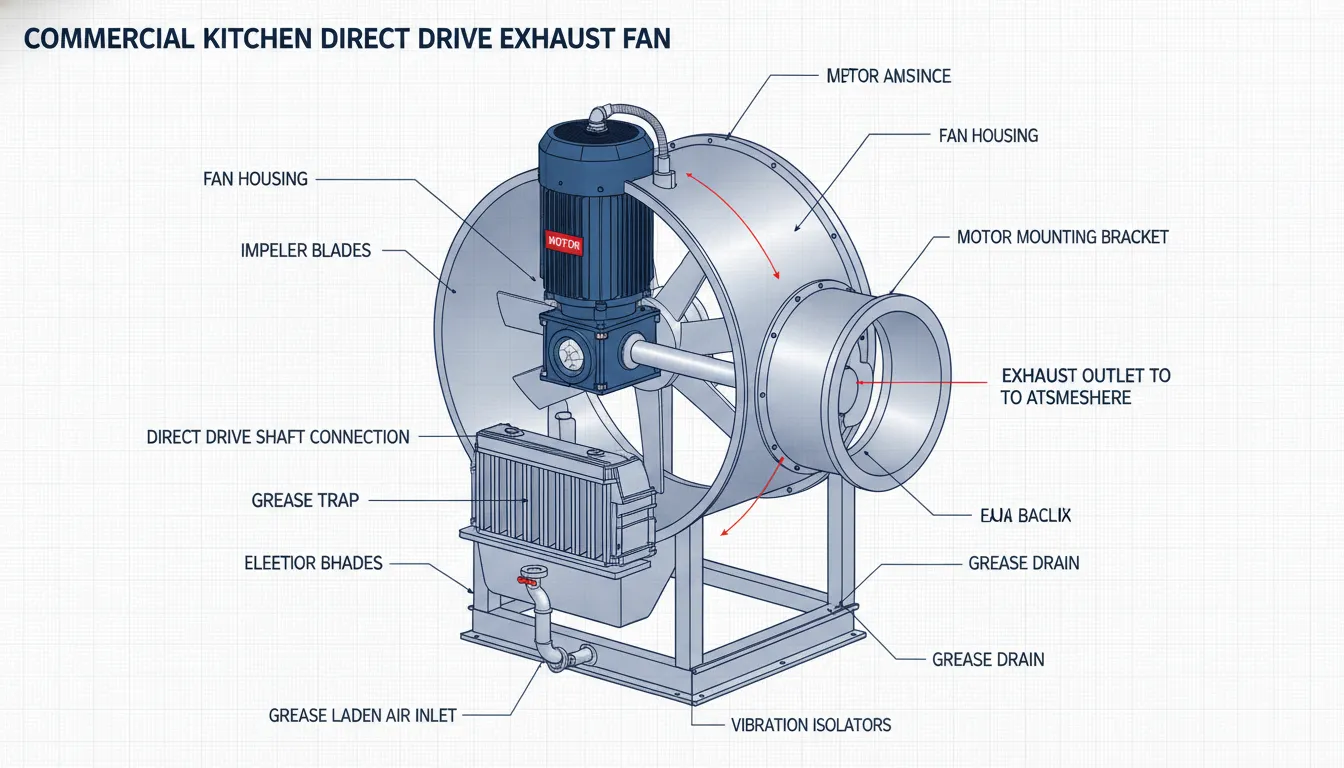
A direct drive exhaust fan is a ventilation system where the fan wheel connects directly to the motor shaft. In this design, the motor drives the fan wheel without any middle parts like belts, pulleys, or extra shafts. This direct link makes the unit very simple and highly efficient. By removing the friction from belts and pulleys, direct drive configurations lose less power and deliver higher mechanical efficiency.
How the direct drive system works
In a direct drive system, the fan wheel is mounted directly on the motor shaft. This means the fan spins at the exact same speed as the motor itself. This configuration is detailed in engineering studies published by the University of Nebraska-Lincoln Extension. Since there are no belts to slip, the fan maintains a steady rate of airflow. This simple design removes the wear and tear common in more complex setups.
Key benefits of direct drive fans
- High reliability. With fewer moving parts, there are fewer components that can break down or wear out over time. According to the U.S. Department of Energy, eliminating belts and pulleys removes the common maintenance tasks of belt replacement, tensioning, and alignment.
- Compact footprint. Direct drive fans take up much less space on a roof or wall, making them ideal for food trucks and small kitchens. The motor is built right into the fan housing, which helps mobile food businesses maximize their limited layout space.
- Excellent speed control with VFD. While direct drive fans operate at a fixed speed by default, you can connect them to a variable frequency drive. This combination gives you both high energy efficiency and precise airflow control.
Drawbacks and limitations
- Heat exposure. Because the motor connects directly to the fan wheel, it sits very close to the hot exhaust stream. This requires a heavy-duty motor rated for high temperatures.
- Limited speed adjustment without VFD. Unlike belt-driven fans where you can change physical pulleys to speed up or slow down the fan. A direct drive fan is stuck at its motor speed without expensive electrical controls.
Typical commercial applications
Because of their compact size and simple setup, direct drive fans are ideal for space-constrained kitchens. They are the top choice for food trucks, concession trailers, and small cafes. In these mobile or small-scale setups, there is no room for bulky belt-driven housings, and operators need a reliable fan that requires very little maintenance. Direct drive units are also common in smaller quick-service restaurants that do not require frequent changes to their airflow levels. AirSupply carries three direct drive upblast exhaust fan models starting at $550 for the 2050 CFM upblast exhaust fan.
What is a belt drive exhaust fan?
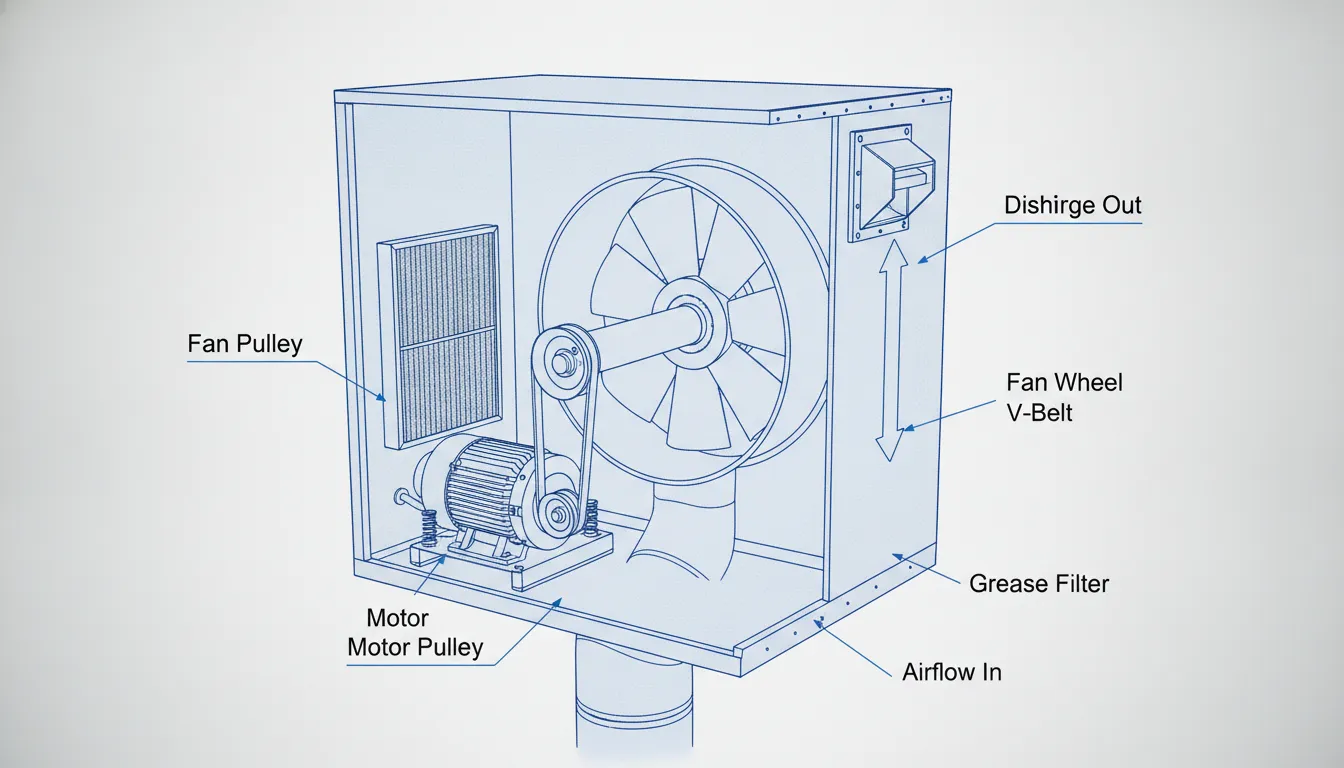
A belt drive exhaust fan uses a mechanical connection to turn the fan blades. Instead of placing the fan wheel on the motor shaft, this design separates the two parts. A belt-and-pulley system connects the motor to the fan wheel shaft to transmit power, as noted by University of Nebraska-Lincoln Extension. This physical separation is the main difference when comparing a direct drive vs belt drive exhaust fan.
Adjustable speeds and balancing
The main benefit of a belt drive fan is control. You can change the fan speed by adjusting the pulley diameter on the shafts. This mechanical adjustment offers great system balancing flexibility without the need for an expensive variable frequency drive. If you need more or less airflow, a simple pulley change alters the fan speed to match your exact needs.
Motor protection and service life
In a belt drive setup, the motor sits outside the hot exhaust airstream. This location is very helpful in grease-laden commercial kitchen hoods. By isolating the motor from harsh grease and heat, the motor lasts longer and experiences fewer electrical issues. If the motor does fail, replacements are easy to find. These systems use standard motor frame sizes, making it simple to source and install a new motor without custom parts.
Performance range and static pressure
Belt-driven fans can achieve a wider range of fan speeds and operating pressures compared to fixed-speed direct drive fans, according to the U.S. Department of Energy. This wide operating range allows the fan to handle long duct runs with high static pressure. Whether you have multiple elbows in your ductwork or a long vertical run to the roof. A belt drive fan can be adjusted to pull the correct volume of air through the system.
Maintenance needs and belt wear
- Regular belt tensioning. Belts and pulleys wear out over time and need periodic tensioning and alignment checks.
- Belt slippage risk. If a belt gets loose, slippage reduces fan performance and lowers the airflow out of your kitchen.
- Annual belt replacement. Operators must inspect these components regularly and replace worn belts to prevent sudden fan failure.
Best applications for belt drive fans
Belt drive fans are the preferred choice for large commercial kitchens, heavy grease cooking, and high-volume restaurants. They are ideal for systems that require high air volumes and precise air balancing during setup. For smaller kitchens or tight setups like food trucks, direct drive models may be more common. But for large, high-static pressure systems, a belt drive fan provides the durability and flexibility required to keep air moving safely.
Direct drive vs belt drive: maintenance, efficiency, and noise
When you choose a commercial kitchen fan, you must weigh how each drive type performs over time. The choice between a direct drive vs belt drive exhaust fan affects your daily upkeep, power bills, and kitchen environment. Both setups have clear trade-offs.
Maintenance and reliability differences
- Direct drive: The fan wheel connects directly to the motor shaft. No belts, pulleys, or extra bearings to wear out. Direct drive units generally require less maintenance by eliminating belt wear, alignment tasks, and pulley adjustments.
- Belt drive: Uses pulleys and rubber belts to spin the fan blades. Belts stretch and wear down over time. You must check tension and alignment often and replace worn belts every year.
Operating efficiency and power loss
- Direct drive: The elimination of belt losses results in higher mechanical efficiency. Direct drive setups convert more electrical power straight into moving air, lowering your monthly energy costs.
- Belt drive: Lose power through belt friction. Typical efficiency reduction is 2% to 5%. If your staff fails to maintain proper belt tension, slippage can increase this power loss even further.
Noise level and vibration control
- Belt drive: Often quieter at lower fan speeds because you can adjust the pulley ratio to run the fan slower. Additionally, belt driven fan assemblies can provide enhanced vibration dampening compared to direct drive models. The flexible rubber belt helps absorb motor vibrations before they reach your ductwork.
- Direct drive: Can be louder because the fan wheel spins at the exact speed of the motor. However, the federal government notes that belt drive fans may generate additional vibration due to belt and pulley irregularities. Direct drive models avoid these specific vibration sources completely.
Upfront and long-term costs
- Belt drive: Often cheaper to buy initially because they use standard, low-cost motors.
- Direct drive: Variable speed capable direct drive motors may have higher initial costs than standard belt drive setups. However, direct drive units usually save you money over time due to lower upkeep costs and better power efficiency.
The table below summarizes the key differences to help you choose the best fit for your kitchen layout.
| Feature | Direct Drive Fans | Belt Drive Fans |
|---|---|---|
| Maintenance | Very low; no belts or pulleys to adjust or replace. | Regular upkeep; requires belt tensioning and bearing lubrication. |
| Mechanical Efficiency | Higher; no power lost to belt friction. | Lower; belt friction reduces efficiency by 2% to 5%. |
| Noise and Vibration | Fewer vibration sources; can be louder at full speed. | Belts absorb vibration; may be quieter at lower speeds. |
| Initial Cost | Higher upfront cost for variable speed models. | Lower upfront cost with standard motors. |
| Long-term Value | Best value; lower utility and maintenance bills. | Higher operating costs due to belt wear and power loss. |
Which motor type does NFPA 96 require for grease-laden exhaust?
Commercial kitchen exhaust systems must adhere to NFPA 96 standards, which specify construction and maintenance requirements. However, the code does not mandate a single drive type. Both options in the direct drive vs belt drive exhaust fan debate can comply if you design and maintain them correctly. Proper exhaust fan selection is crucial to meeting these fire safety goals.
Protecting the motor from grease and heat
- Belt drive advantage: The motor sits outside the hot exhaust stream, protecting it from harsh kitchen grease conditions. This physical separation can improve motor longevity.
- Direct drive concern: The motor sits closer to the fan wheel, making it more susceptible to motor failure from heat transfer if not properly isolated. Direct drive motors must be carefully selected to handle the ambient heat found in kitchen exhaust streams.
The need for regular cleaning and inspection
Both drive types must be kept clean to meet safety codes. Regular cleaning is a core part of compliance. Grease can build up on fan blades and motors, creating a fuel source for fires. While a direct drive fan has fewer parts to clean, a belt drive fan has belts and pulleys that can catch grease. If you choose a belt drive, you must perform regular checks to keep the system in safe working order. A clean fan runs safer and prevents dangerous fire hazards in your ductwork.
How fan selection impacts compliance
Your choice of fan also affects the overall ventilation setup. To ensure compliance, you must pair your exhaust fan with high-quality ventilation hoods. A well-designed hood works with the fan to capture grease and smoke before they can spread. The entire system must pull air at the right rate to satisfy safety inspectors. Whether you select a direct drive unit with standard speed control or a belt drive unit with mechanical adjustments. Proper sizing remains the key to code compliance and kitchen safety. For a complete overview of how all the components fit together, read our Commercial Kitchen Exhaust Fan Buyer's Guide.
Which AirSupply models are direct drive and which are belt drive?
When you set up a kitchen, choosing the right fan drive type is vital. AirSupply simplifies this decision by offering a clear, focused lineup of equipment. All upblast exhaust fans in the AirSupply catalog are direct drive models. This design choice is intentional, as it maximizes mechanical efficiency by mounting the fan wheel directly on the motor shaft. By focusing on direct drive, AirSupply ensures your system has fewer moving parts to maintain or replace over time.
The AirSupply direct drive lineup.
The AirSupply inventory includes three specific direct drive upblast exhaust fans designed for different kitchen scales:
- 2050 CFM fan at $550 , Ideal for small operations, food trucks, and concession trailers.
- 2500 CFM model at $650 , Suited for mid-sized restaurants and cafes.
- 4000 CFM fan at $750 , Designed for higher-volume commercial kitchens.
These direct drive exhaust fans deliver steady performance without the risk of belt slippage, which can decrease airflow if a belt loses its tension over months of heavy use. For a deeper look at how the direct drive mechanism works, see our Direct Drive Upblast Exhaust Fan guide.
Flexible hood pairings for either drive type
While the exhaust fans themselves are direct drive, AirSupply's Type C ventilation hoods. Which range from 4 to 12 feet in length, are fully compatible with both direct drive and belt drive setups. If your kitchen layout or local codes demand a belt drive fan, you can pair one with any of these ventilation hoods. This modular approach gives you complete control over your layout. A successful commercial kitchen setup requires coordinated performance between the exhaust fan, the ventilation hood, and the make-up air unit. For food truck operators, we also have a dedicated food truck ventilation equipment guide covering compact setups.
How the component-based model saves you money
AirSupply does not sell turnkey integrated packages. Instead, they use a component-based business model. You buy the fan, the hood, and the make-up air unit separately. This approach helps restaurant operators save 60-70% on ventilation system costs compared to expensive integrated packages sold by traditional installers. To find the right setup for your space, you can get a free sizing consultation with an expert who will guide you to the perfect components for your specific kitchen footprint.
Ready to get the right exhaust fan for your kitchen?
Whether you need a compact direct drive fan for your food truck or a flexible belt-driven system for a full restaurant kitchen. Getting the right exhaust fan is critical for safety, compliance, and efficiency. AirSupply's team of ventilation experts can help you size and select the perfect exhaust fan for your specific needs. Every kitchen is different, and the best drive type depends on your cooking equipment, duct layout, space constraints, and budget.
Call us today at (832) 540-7936 for a free sizing consultation. Our team will help you compare direct drive and belt drive options, explain the cost difference, and ensure your ventilation system meets NFPA 96 requirements. Or visit our contact page to send us a message.
Frequently Asked Questions
What is the main difference between direct drive and belt drive fans?
The main difference lies in how they connect the motor to the fan. Direct drive fans connect the fan wheel right to the motor shaft. Belt drive fans use belts and pulleys to transmit power from the motor to the fan shaft.
Are direct drive fans more energy efficient?
Yes. Direct drive systems are more efficient because they do not lose power to belt friction. According to the U.S. Department of Energy fan sourcebook, removing belt losses leads to better overall mechanical efficiency.
Which fan type requires more maintenance?
Belt drive fans need more work. You must check belt wear, adjust tension, and align pulleys. Direct drive fans have fewer moving parts, making them almost maintenance-free.
Which fan type is better for commercial kitchen exhaust?
Both comply with codes, but belt drive fans are often preferred for hot, greasy kitchen exhaust because the system isolates the motor from the harsh air stream. Direct drive fans work well for compact spaces like food trucks but need heat-rated motors.
How much does a direct drive upblast exhaust fan cost from AirSupply?
AirSupply offers three sizes: a 2050 CFM fan at $550, a 2500 CFM fan at $650, and a 4000 CFM fan at $750. All are direct drive models with no belts to maintain.